
Why the human check on AI belongs at the start, not the end
Your AI is saving your team hours, and your team is spending a third of those hours checking its work.
In February, I wrote about a problem I saw coming: the better the models get, the less closely people check them, right when the stakes go up. My answer was simple. Let the AI draft the work and make a human sign off before anything ships.
I was half right. The problem was real. But I put the human check at the end, after the AI had already done the work. It belongs at the start.
We work with a Chief Revenue Officer who learned this the hard way. She asked an AI model why her deals were slowing down and got answers she said had “nothing in line with reality.” Her forecast was wildly off. The model wasn’t broken. It had never been told anything true about her business.
On Saturday, The New York Times put a price on that sign-off. It called it a “verification tax”: the human time it takes to confirm AI output is accurate, safe and usable before anyone acts on it.
The numbers are hard to argue with. In a poll of nearly 6,000 senior executives, 69% said their firms use AI, and about 90% said it has had no impact on employment or productivity. In a separate survey, Workday found employees spend roughly 37% of the time AI saves them correcting, clarifying or rewriting what it produced.
Now put that inside a revenue team. Give 20 reps AI agents that research accounts, draft sequences and update deal records, and each rep gets back 10 hours a week. Apply Workday’s 37%, and 74 of those 200 hours go straight back into checking the agents’ work.
At a fully loaded $75 an hour over a 48-week year, that’s roughly $266,000 of your best sellers’ time spent proofreading software. You didn’t budget for it. You’re paying it anyway.
Berkeley’s Ion Stoica explains where the cost comes from. Some work is easy to check: is the maze complete? Other work depends on judgment an expert has never written down: is this a good contract?
Your pipeline is full of both. “Is this discount inside the approved band?” takes a rep five seconds when the band is written down. “Is this a good deal?” takes your VP of Sales twenty minutes, because the answer lives in her head.
Even what is written down rarely agrees. Slack says you target enterprise, last week’s pipeline review said SMB first, and the strategy deck says something else. An AI reading all three has no way to know which is true, so a person has to step in.
A sign-off at the end breaks at scale for exactly this reason. When the judgment exists only in your best people, every AI output must route through them, and your most expensive people become the bottleneck on your cheapest labor.
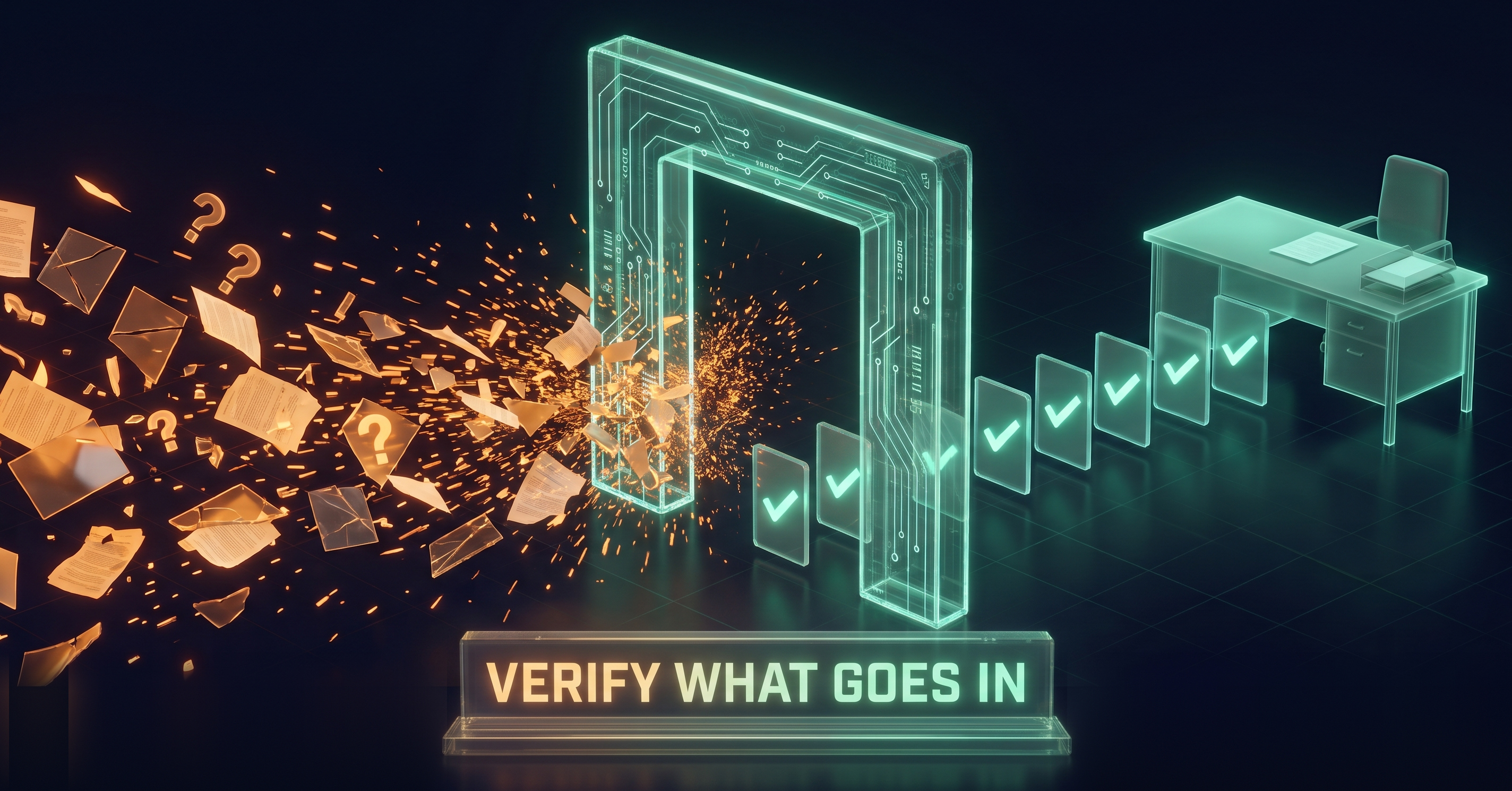
The fix isn’t more reviewers. It’s checking in a different place: verify what the AI reads before it acts, instead of checking everything it produces afterward. You confirm the five facts every email depends on once, rather than reading a thousand emails one at a time.
It starts with a verified record of the business: your ideal customer, current pricing, approved proof points, stage definitions, the decisions leadership has already made and the ideas it has already rejected. Proven facts stay separate from educated guesses and opinions, and the AI knows which is which. A named owner checks the record every month for drift.
Every AI workflow then checks that record before it runs. If what it needs is missing or stale, the workflow waits instead of guessing. Here’s what this looks like inside a GTM team:
None of these agents is smarter than the one your team uses today. They just refuse to guess.
Checking upstream also closes the shortcut most teams try next, which is putting a second AI on the review desk. MIT’s Christian Catalini warns that when the expertise was never written down, “all the blind spots will be completely correlated” between the AI doing the work and the AI checking it. An agent checking against your verified record isn’t repeating the first agent’s guesses. It’s checking against your business.
KPMG U.S. CEO Tim Walsh told the Times his firm keeps a human check in every process it automates. He’s right. The human check stays. It just moves, from reviewing every output to owning the record every output depends on.
Your reps spot-check a sample instead of reading everything. Leadership approves the decisions that matter once, instead of reviewing their consequences a thousand times. And someone owns the record, because pricing, positioning and your ideal customer all change.
Left alone, a record drifts within weeks: competitive intelligence first, then priorities, then deal status. We’ve seen a competitor become a partner while the AI kept writing battle cards against them, because nobody updated what it reads.
This is the system we build and run at Traction AI: the verified context your agents read, and AI workflows that won’t act on anything unverified.
Every company running AI is paying to check its work. The only decision left is where you pay: at the end, one output at a time, with your best people’s hours, or at the start, once, against a record you own.
So ask your leadership team one question this week: how many of your AI’s outputs land on a human desk because nobody verified what the AI read first?
The model is rented. The context is yours.


