
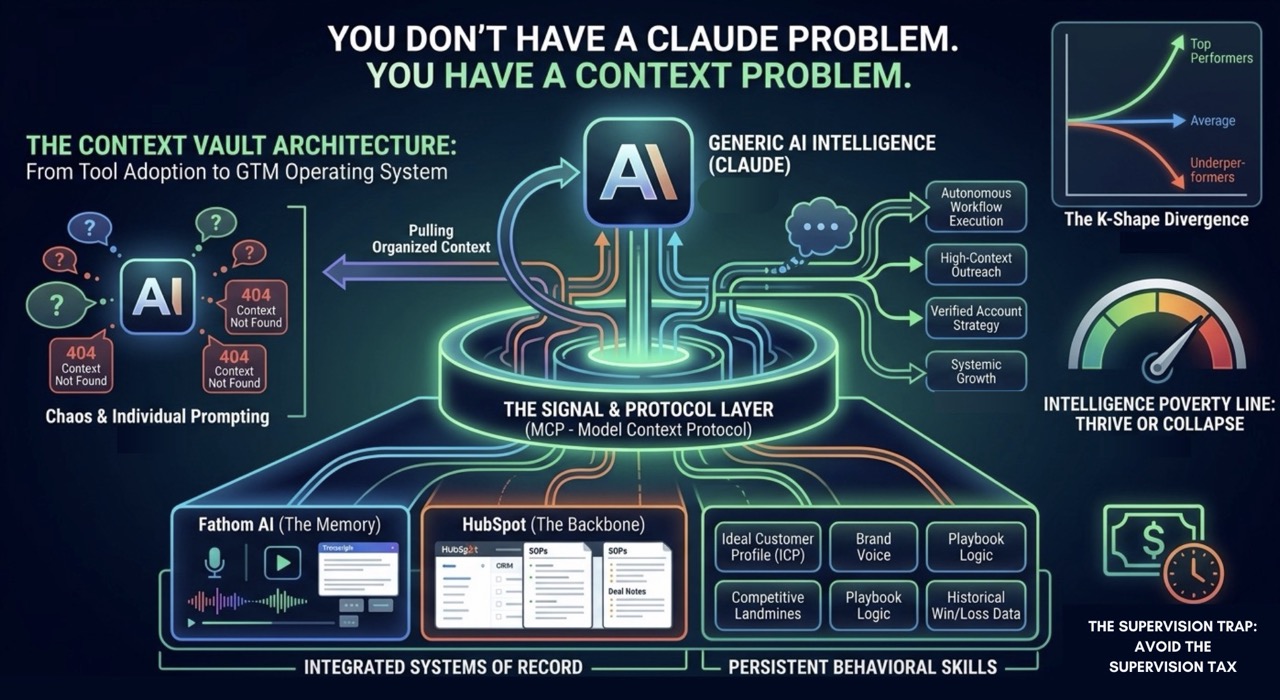
Most GTM leaders are currently staring at an AI bill they can't justify, asking the wrong question: Is this model smart enough? They see headlines about Anthropic’s soaring enterprise adoption, buy a fleet of licenses, and wait for the magic to happen. Then the board deck arrives, and the revenue line hasn’t budged.
The immediate reaction is to blame the tool. But you don't have a Claude problem. You have a Context Problem.
The real differentiator in 2026 isn't the AI itself—it's the signal and context layer sitting underneath it. We are drawing a hard line between renting generic model intelligence and owning systemic logic. If you skip the infrastructure, you don't just fail to scale; you actively fracture your organization.
The "Hype Hangover" in Numbers
The "tools are bought, results aren't happening" narrative is exploding across tech. The data behind this disconnect is stark:
Why is the gap so massive? Because most companies bought the engine (Claude) but forgot to build the fuel tank (The Context Vault) that makes it work for their specific business.
Renting Intelligence vs. Owning Systemic Logic
When you buy a standard AI seat license and hand it to a rep, you are renting intelligence. You are trapped on the wrong side of the shift, relying on short-lived, ephemeral sessions that possess no institutional memory.
Every morning, your reps open a blank chat window. They run an experiment, get a decent email draft, and close the tab. The moment that window is closed, the session completely forgets who you are, what you sell, and why you win. The 50th prompt is no better than the first because nothing compounds.
On the right side of the shift, you move from chatting to “operating” inside a AI system.
Instead of asking a generic LLM to "write a sales email," you inhabit a persistent environment where the AI has already absorbed your Ideal Customer Profile (ICP), your brand voice, your competitive landmines, and your historical win/loss data. The system, not the individual person, maintains the operational standard.
The "K-Shape" Divergence: The Illusion of Leverage
When you deploy Ephemeral AI across a team without a shared infrastructure, you don't get a uniform productivity lift. Instead, you trigger a sharp organizational divergence—what we call the K-Shape Effect: an organizational phenomenon where AI wildly accelerates your top performers while simultaneously magnifying the mistakes of your weakest links.
Imagine your standard talent bell curve. When raw AI hits that curve without a centralized context layer, it acts like a prism, refracting performance into completely opposite directions:
Suddenly, your bottom tier is shipping low-context garbage at scale. As an organization, your results suffer even when some individuals thrive. You end up spending half your week individually refuting corrupted findings, correcting hallucinated HubSpot conclusions, and providing the missing detail after the fact.
The Leverage Reframe: Expertise is the Multiplier, Not the Bottleneck
At a recent AI agentic event in New York City, Tim Shea from Lattice Work introduced a similar prism metaphor and concluded that because of this divergence - individual domain expertise is the only true competitive advantage left.
The narrative goes: “If you have deep domain expertise, your position is secure. Go get more of it.”
That is directionally the right observation, but it asks the entirely wrong question. If your strategic solution to AI is simply telling individuals to "go get more expertise," you are treating a systemic corporate problem as a personal development goal. You are still relying on heroic, individual efforts to save your margins, turning human talent into your tightest growth constraint.
The question unasked by most executive teams is this:
How do you design an AI experience where you take the domain expertise of your top 1% rock stars, embed it into the software architecture, so the bottom achievers can become solid, average performers, and the average performers can become half of the 10xers?
Leverage is a lot like debt. If you have equity in an asset, you can borrow against it to build wealth. But leverage multiplied by zero is still zero. If your reps don't have the baseline domain expertise, giving them a faster AI tool just helps them make mistakes at terminal velocity. You don't need AI to replace your people; you need AI to multiply your institutional expertise.
The Real Cost: The Supervision Trap
When you skip building this architecture, you trigger the Supervision Trap—a state where a leader is operationally responsible for the AI's actions but physically unable to monitor them all.
If an autonomous agent drafts a prospect brief or an account strategy, but a manager has to spend ten minutes reviewing it for accuracy, voice, and positioning, you haven’t unlocked operating leverage. You’ve simply shifted labor from doing to supervising.
You are left paying a steep Supervision Tax—the hidden cost of human labor shifted from doing the work to babysitting and correcting the AI's output. Your costs scale right alongside your success, and your margins stay completely flat.
True leverage only happens when the reasoning density of your system allows you to cross the Intelligence Poverty Line—the invisible threshold where a company's unit economics either thrive through autonomous software logic or collapse under the weight of human overhead. This requires AI Governance—a management framework where leaders audit the transparent, step-by-step logic chains of an AI rather than reviewing thousands of individual text outputs.
The Strategic Anatomy of a Context Vault
To force the entire K-shape organization upward, your GTM stack must move from tool adoption to a unified engine using three distinct layers:
1. Persistent Behavioral Skills
A "Skill" is not a prompt template; it is a brand-configured behavioral layer. By locking down your historical data and playbook logic, the AI gains the institutional memory of a 10-year veteran employee. The system, not the person, maintains the standard. You move from a state of chaotic, individual prompting to becoming a Curator of Logic.
2. The Signal and Protocol Layer (MCP)
Without connectivity, expertise is marooned. By utilizing the Model Context Protocol (MCP), your context layer connects directly to your live software environment. It allows the model to bridge the gap between reasoning and action—moving seamlessly between your data streams to execute workflows autonomously.
3. Integrated Systems of Record
The vault continuously ingests live signals to prevent context decay, creating a living reference library that reasons on behalf of the GTM team:
Conclusion: The New Board Mandate
The era of casual AI experimentation is dead. Boards are no longer accepting "AI adoption" as a metric; they want to see it reflected in the unit economics of the P&L.
You still need go-to-market experts. You need people who know how to translate business results into go-to-market processes and embed that expertise straight into your systems to achieve those efficiency gains.
If your AI infrastructure doesn't know your specific HubSpot triggers, your active Fathom signals, or your core competitive landmines, it’s not an operating system. It’s just a toy.
Stop blaming the models for failing to understand a business you haven't taught them yet. Build the infrastructure, own your systemic logic, and build a machine that learns faster than your competitors.
Are your sales and marketing teams actually building an asset, or are they just running manual experiments in a blank chat box?


