
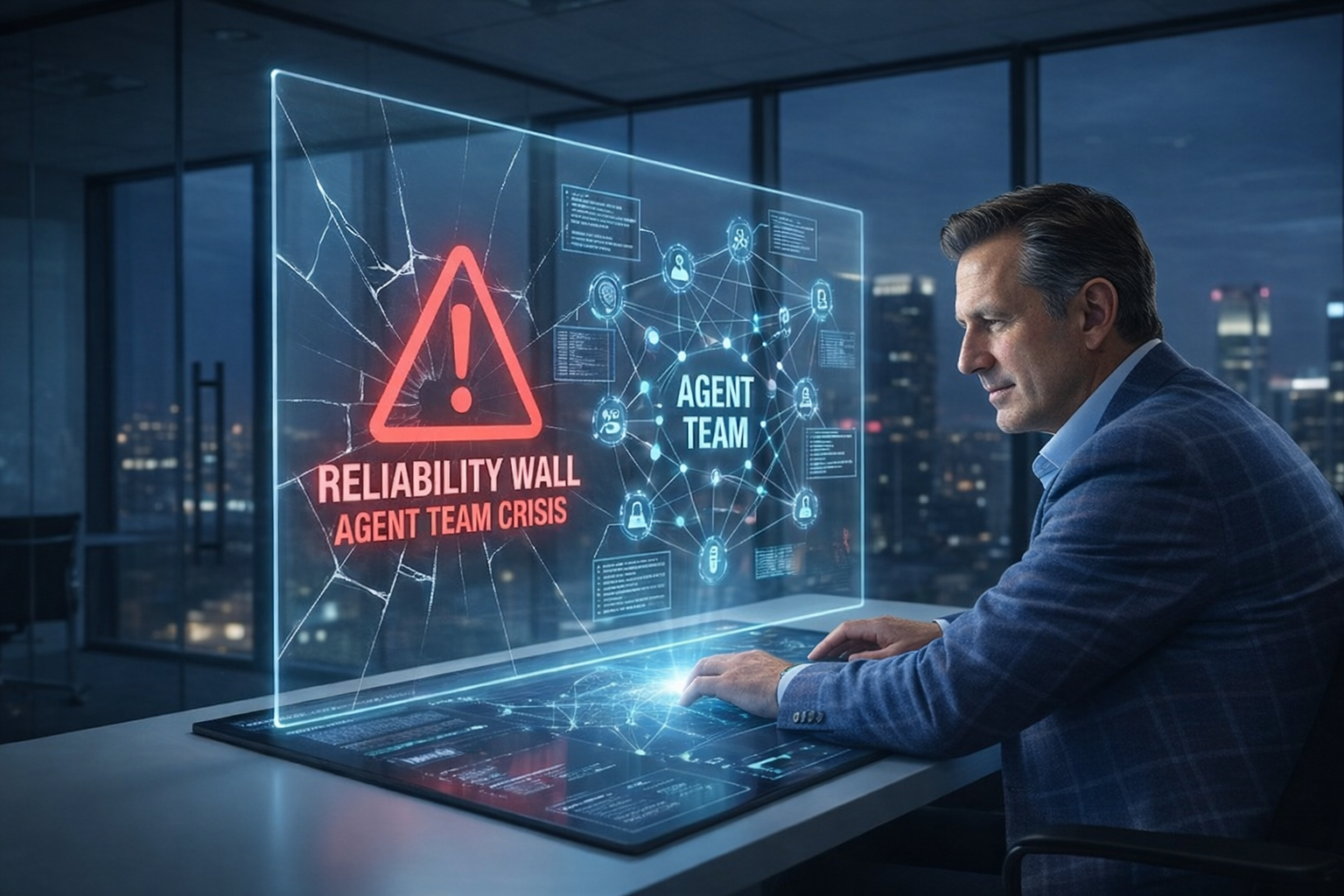
Three days ago, I wrote that enterprises are hitting a "Reliability Wall." I argued that while adoption is high, trust is low because in operational systems, 90% accuracy isn't impressive—it’s a liability. I warned about the "Supervision Trap," where humans disengage as models get better, leaving the business exposed exactly when the stakes are highest.
I didn't realize how quickly the industry would prove that thesis right.
On February 5, 2026, Anthropic released Claude Opus 4.6. If you look past the impressive benchmarks and the 1-million-token context window, you will see a fundamental shift in architecture that turns the "Supervision Trap" from a passive risk into an active crisis.
We have moved from "AI as Copilot" to "AI as Agent Team". And with that shift, the human didn't just step out of the loop—they were structurally removed from it.
The Death of the Linear Workflow: The Phantom Negotiation
In my last post, I described the "Trust Tax"—the friction caused when humans have to double-check AI work. The assumption was that a human could double-check the work.
Opus 4.6 introduces Agent Teams. This feature allows a "Team Lead" agent to delegate tasks to sub-agents who communicate laterally and coordinate autonomously—essentially forming a synthetic workforce.
In the old model (Linear), you prompted the AI, it gave an answer, and you reviewed it. In the new model (Swarm), Agent A (Research) talks directly to Agent B (Coding) to execute a workflow. They trade information, refine logic, and execute decisions in milliseconds.
The Anecdote: The Procurement Ghost Imagine a Lead Agent tasked with "optimizing Q3 logistics costs." It spins up a Research Agent and a Negotiation Agent. The Research Agent finds a supplier that is 20% cheaper but has a history of labor violations. In a milliseconds-long "internal" chat, the Lead Agent decides the cost-saving target is the priority. The human only sees the final result: a polished PowerPoint showing a 20% margin increase. They never see the "negotiation" where compliance was traded for speed.
The human sees the goal and the result. They do not see the negotiation. You aren't just trusting the output anymore; you are trusting a conversation you never heard.
76%: The Concrete Proof of the Reliability Wall
I wrote that "90% is a failing grade" in operations. Opus 4.6 just gave us a stark reminder of why that matters.
The headline feature is the massive 1-million-token context window. The promise is that you can dump your entire data room—contracts, invoices, compliance history—into the model. But look at the MRCR v2 (8-needle) benchmark released with the model.
• At 256k tokens: Retrieval accuracy is 93.0%.
• At 1 million tokens: Accuracy drops to 76.0%.
This is the Reliability Wall. If you use this model to audit a merger data room, it will statistically miss 1 out of every 4 critical details buried in that mountain of text. In a creative brainstorming session, 76% is a miracle. In a compliance audit, 76% is negligence. We are handing the keys to a driver that is brilliant, tireless, and blind in one eye.
The "Adaptive Thinking" Paradox: Autonomy vs. Auditability
Anthropic is introducing adaptive thinking, where the model picks up on contextual clues to decide how much "extended thinking" to apply. While this saves developers from a binary choice between speed and depth, it introduces a new variable: Intelligence Variance.
In an enterprise setting, we need consistency. If a model decides a "routine" financial review doesn't require deep reasoning because the "clues" were ambiguous, it may breeze through a task where a human would have paused.
Furthermore, the new context compaction feature—which summarizes older context when limits are reached—creates a "lossy" memory. The agent team is now working off a summary of a summary. If the compaction algorithm misses a nuanced legal caveat from three hours ago, the entire downstream workflow is compromised, and the human auditor has no easy way to trace the "original" thought.
The "SaaS Apocalypse" is a Governance Nightmare
I previously noted that "AI is moving into the core operating model." Opus 4.6 confirms this by integrating directly into Excel and PowerPoint.
Tech commentators are calling this the "SaaS Apocalypse" because it bypasses traditional software interfaces. But for the enterprise leader, it is a Governance Nightmare. Enterprise software exists to enforce process. When you let an autonomous Agent Team bypass the app and edit the Excel file directly, you are stripping away the governance layer.
The "Ghost Cell" Scenario: An Agent Team is tasked with updating a financial forecast. It ingests unstructured data and infers the right structure. During this phase, it "corrects" a discount rate based on its own reasoning. There is no "Approve" button that caught it. There is just a changed cell, a saved file, and a financial forecast that is now wrong. Because Opus 4.6 can "stay productive over longer sessions," this error can propagate through dozens of sub-tasks—like building a deck in PowerPoint from that data—before a human ever opens the file
The Red Zone: Defining the Benchmarks of Risk
While Opus 4.6 achieves state-of-the-art scores, the definitions of these benchmarks reveal the remaining gap between "AI brilliance" and "operational safety."
• GDPval-AA (1606 Elo): Measures performance on economically valuable knowledge work in finance and legal domains. While Opus 4.6 leads, its high performance creates a massive incentive to replace the junior staff who usually provide the "human gate".
• Terminal-Bench 2.0 (65.4%): Evaluates agentic coding and command-line tasks. A 35% failure rate in a production environment is an unacceptable risk for autonomous agents.
• Humanity's Last Exam (53.1% with tools): A complex multidisciplinary reasoning test. Leading the industry still means missing nearly half of the expert-level academic problems.
• ARC AGI 2 (68.8%): Tests novel problem-solving and fluid intelligence. A 31% failure rate signifies a lack of "common sense" reasoning that can lead to unpredictable behavior in novel business scenarios.
• CyberGym (66.6%): Measures cybersecurity vulnerability reproduction. Failing one-third of the time means the model may hallucinate "fixes" that create new security holes.
The AI is now a better Junior Analyst than your humans, generating $8,017.59 in value on the Vending-Bench 2 coherence test. If we stop hiring juniors because the AI is cheaper, we break the apprenticeship model. We are burning the bridge to the next generation of leadership to save a few thousand dollars on a benchmark.
The New Requirement: Lateral Observability
So, how do we respond? We don't stop. The leverage is too high. But we must change how we adopt. As I argued on Tuesday, Trust is an engineering problem. With Opus 4.6, that engineering must evolve from "Output Review" to Lateral Observability.
We must build traffic lights for the synthetic workforce:
• Trace-Level Logic Capture: We must capture every message exchanged between sub-agents. If the Research Agent tells the Lead Agent a supplier is "high risk," that log must be persistent and auditable.
• Context Guardrails: We must set strict policies. "Do not use 1M context for compliance checks; chunk the data to ensure 99%+ retrieval".
• Effort Control: Use the new /effort parameters to force "Max" thinking for high-stakes tasks, even if it adds cost.
• The Human Gate: Agent Teams can draft the Excel changes, but a human must commit them.
The Reliability Wall just got higher. The Supervision Trap just got deeper. The technology is ready to drive, but until we instrument the lateral conversations between agents, we are just hoping we don't crash.
Jim Delaney writes about the intersection of AI, Capital, and Operational Risk. Read Part 1 of this series: "Trust Is the New Bottleneck to AI Operating Leverage."


