
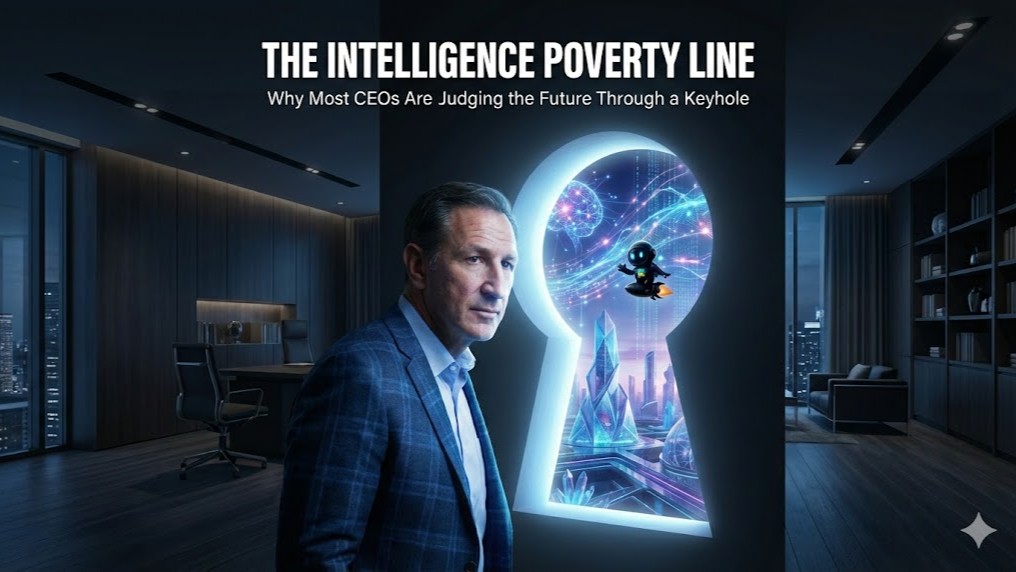
Matt Shumer’s recent viral essay, "Something Big Is Happening" generated over 30 million impressions in its first 24 hours — instantly igniting debate across founders, investors, and enterprise leadership teams.
Some called it hype. Others called it fear-mongering. A few called it inevitable. But all sides are arguing the wrong question. After advising founders, investors, and enterprise leadership teams through the volatility of the past year, one pattern has become impossible to ignore: The real divide emerging in business today isn’t between optimists and skeptics.
It’s between leaders experiencing modern AI — and those unknowingly evaluating a downgraded version of it. I call this divide The Intelligence Poverty Line.
Every technological revolution creates inequality before it creates growth. Electricity. The internet. Cloud computing. Each followed the same arc: early adopters didn’t simply move faster — they began operating inside an entirely different reality. AI has now crossed that threshold.
The data tells the story:
The uncomfortable implication is this: Most strategic opinions about AI are being formed using systems intentionally designed with limited capability. Leaders are judging the space age while still standing on the runway.
The widespread skepticism around AI isn’t irrational — it’s experiential. Most executives are interacting with constrained versions of the technology.
Three structural gaps explain the disconnect.
Limited environments force AI to operate with capped memory. When a model loses track of a complex audit, strategy document, or large codebase, the conclusion feels obvious:
“AI isn’t ready for prime time.”
Reality: Enterprise users now operate models with multi-million-token context windows. They are no longer using chatbots. They are working with something closer to an institutional historian — systems capable of retaining and reasoning across entire organizational knowledge bases.
Most users interact with fast-response models optimized for convenience. The experience resembles advanced autocomplete.
Reality: Frontier systems have shifted toward deliberate reasoning. Modern models pause, simulate outcomes, evaluate alternatives, and self-correct before responding. We have quietly moved from: Answer Generation → Decision Support. The distinction is existential for executive leadership.
The public still treats AI like a search engine. You type. It responds.
Reality: Leading organizations have stopped prompting and started deploying. Agentic systems now:
AI is transitioning from software tool to operational participant.
The greatest risk isn’t sudden job displacement. It’s Asymmetric Adoption.
In the late 1990s, every retailer had access to the internet. Most used it as a digital brochure. A small minority reorganized their entire operating model around it. We remember those companies today as Amazon and Netflix. AI is creating a similar bifurcation.
Organizations experimenting with AI as productivity software:
Organizations treating intelligence itself as infrastructure:
Two groups. Two operating realities. One widening gap.
The leadership question is no longer:
“Is AI real?”
The real question is:
Are we allocating capital and strategy based on yesterday’s capability?
If executive teams are building 2026–2030 forecasts based on experiences with free-tier AI systems, they risk committing a form of strategic malpractice. Once a competitor crosses the Intelligence Poverty Line, catching up becomes exponentially harder. Their labor becomes an appreciating software asset. Yours remains a depreciating overhead cost.
Every technological revolution follows a predictable pattern:
The winners are rarely the loudest voices in the debate. They are the leaders who recognize the structural shift before consensus arrives. The Intelligence Poverty Line has already emerged.
The only remaining question is: Which side of it is your organization operating on today?


