
In my last post, I wrote about the shift from disconnected AI hacks to something more meaningful: a unified operating engine. A system where the output of one workflow becomes the input to the next. Where intelligence compounds instead of resetting every time someone opens a new prompt window.
With the release of Open AI’s GPT-5.4 and its 1M token context window, that vision just crossed a major threshold. The technical barrier to building systems that learn has effectively disappeared. For the past two years, most companies have treated AI like a chatbot—useful, but shallow. Every interaction started from zero.
That era is ending.
We’re moving past the age of "chatting" with AI and entering the age of the Context Vault.
The Hidden Tax Most GTM Teams Pay
If you spend enough time inside revenue organizations, you start to notice a pattern: context decay. Information is constantly being generated, but very little of it compounds. Product teams update roadmaps while sales teams hear objections, but these signals rarely accumulate into something durable.
Your SDR doesn’t know what the product team promised last quarter; Marketing doesn’t know the specific, nuanced objection that killed a deal three months ago. Every time a rep has to ask for the status of an account or what customers think of new pricing, your organization is paying a Context Tax. It results in slower decisions, duplicated work, and endless internal clarification meetings.
Why 1M Tokens is the New “Operating Leverage”
For years, AI couldn’t solve this because it suffered from the same limitation: short-term memory. You could feed it a transcript, but you couldn't feed it the business.
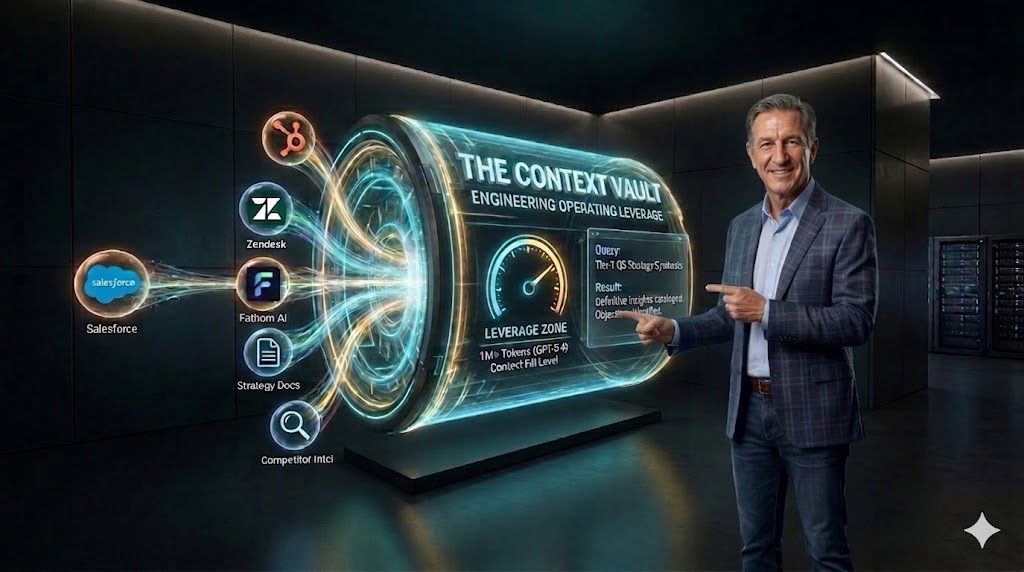
A 1M token context window—more than doubling previous limits—changes the math of execution. It allows you to stack your entire system of record—calls, CRM notes, strategy docs, and competitor intel—into a single working memory that AI can reason across in real time. Not search—reason. That distinction turns out to matter a lot.
Case Study: The $20B Pivot to Precision
The market is already validating this shift toward high-context systems. Anthropic is now approaching a $20 billion annual revenue run rate as users migrate away from basic chatbot usage.
The Lever: This growth is driven by GTM teams who realized that general-purpose hacks fail at scale. Users are moving to Claude because it offers the precision required to handle massive datasets. As Nvidia scales back direct investments to focus on IPOs, they are signaling that the "Model Wars" are secondary to contextual implementation. The winner isn’t who has the best model, but who has the best Context Vault. The competitive advantage is no longer just intelligence; it’s institutional context.
The Architecture of the Vault
To build a system that actually learns, stop thinking about prompts and start thinking about data streams. Here is how the 2026 GTM stack actually looks when integrated into a 1M token window:
When these systems sit inside a single reasoning window, AI starts doing what the best operators inside your company already do instinctively—except it does it across every signal simultaneously.
From Search to Synthesis: The Architecture of Reasoning
For the last twenty years, most software was designed around search. You looked for information, retrieved it, and interpreted it yourself. The real breakthrough of large-context AI systems is synthesis.
Instead of asking, “Find me the notes from this call,” you can ask: “Based on the last thirty discovery calls and our Q3 product roadmap, which features should we emphasize for Tier-1 accounts currently in the evaluation stage?” In the traditional RevOps world, answering that requires two weeks of manual analysis. In a Context Vault system, it becomes a 30-second query. This velocity allows your strategy to evolve faster than the market can destabilize it.
Operational Prompt: The “Total Knowledge” SDR Audit
Once you have a functioning Context Vault, entirely new workflows become possible. We’ve been experimenting with the Total Knowledge SDR Audit. This uses the "Extreme Reasoning" capabilities of GPT-5.4 to turn months of scattered transcripts into a predictive GTM engine.
Imagine feeding three months of sales transcripts, "Closed-Lost" HubSpot notes, and your roadmap into the system. You can then ask the vault to identify "Hidden Friction":

The Shadow Curriculum: Systems That Learn
Every company has a shadow curriculum—the unwritten knowledge that top performers accumulate over time. These are the analogies that lower skepticism and the questions that reveal if a deal is real.
When your institutional memory is captured inside a reasoning system, this curriculum becomes visible. Instead of generic onboarding modules, the system surfaces the exact conversational patterns that lead to success. New hires inherit experience rather than just theory.
The 1M token window is essentially a vacuum that will absorb whatever context you provide. If that context represents the real operational history of your company, you move from "Writing" to "Reasoning". You build an organization that learns faster than its competitors.
So the question is simple: Are you still operating with short-term memory, or are you building a Context Vault that turns every interaction your company has ever had into fuel for the next one?


