
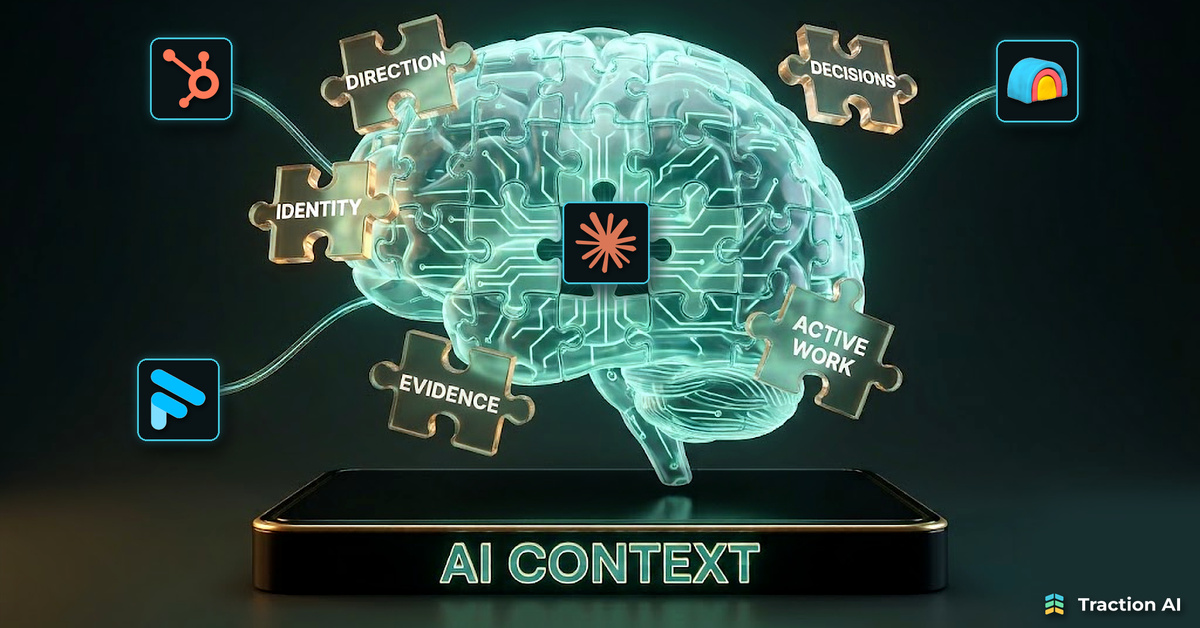
Every go-to-market team has AI now. Few have AI they trust.
Walk the floor and you’ll see why. Your top AE runs ChatGPT on a prompt she wrote herself. Your SDRs use a browser extension nobody in marketing has seen. Marketing pastes last year’s messaging into Claude. Customer success summarizes calls in a tool IT never approved. That’s four teams with four versions of your ideal customer, your pitch and your pricing, and nobody checking what goes out the door. Last month, two of your reps quoted the same prospect two different prices.
The model isn’t the problem, and neither are the tools. The problem is the business context your AI runs on: scattered across ten systems, stale within weeks and owned by no one. With no shared source of truth and no guardrails, every user gets a different answer. Feed an AI agent bad context and it won’t slow down. It will repeat the same mistake on every account it touches.
Context-Driven AI for GTM fixes this. And this fall, the two biggest platforms in GTM admitted the problem is real.
In September, HubSpot rebuilt its platform around AI agents and the context that feeds them. HubSpot says customers whose AI runs on high-quality context win 3.2x more deals. (HubSpot is comparing AI with good context against no AI at all, so treat the number as a strong signal, not a controlled result.)
The same month, Salesforce put 37 prebuilt sales skills inside Claude.
Taken together, the two launches tell every CEO the same thing. The AI model is rented. The skills are becoming a commodity. The context your AI runs on is the one asset you own. Most companies never had a Claude problem. They had a context problem.
Ask where your business context lives today and the honest answer is everywhere. Your positioning is in a deck. Your win and loss reasons are in CRM notes and call recordings. Your competitive intel is in Slack. Your priorities are in last quarter’s planning doc. The judgment behind your best rep is in that rep’s head.
Within weeks, the context is stale. Within months, it contradicts itself. Your three regional VPs each define a qualified opportunity differently, and your AI has no way to know which one is true.
This is your go-to-market institutional memory, and it is scattered across your systems and a dozen people’s heads.
AI does not stop when its context is wrong. It fills the gaps with confident answers: the wrong ideal customer, an old competitor story, last quarter’s pricing. Nobody notices until it shows up as a stalled deal or a missed number.
We call this gap Context Debt: the distance between what your AI needs to know to act correctly and what your systems actually record. Like any debt, it builds quietly, and you pay interest every time an AI agent acts.
Picture a company with $40 million in annual recurring revenue that turns on its AI agents this month.
None of these agents is broken. Each one does exactly what its context tells it to do. A rep with bad context makes a mistake once. An agent makes it a thousand times before anyone checks. This is the Supervision Trap at scale.
The market is offering CEOs three ways out. None of them pays down the debt.
Skill packs. A $99 course will teach your team to build AI skills in an afternoon, and Salesforce now ships skills prebuilt. Useful, but not enough. Every skill still reads whatever context it is given, and skills running on bad context produce wrong answers faster.
Context scores. HubSpot’s new Context Home rates how complete your context is inside HubSpot. Use it. But your context lives in your CRM, your call recorder, your enrichment tools, your docs and your people. A score inside one system measures only part of the debt. Funding AI on a score alone is funding it on vibes.
One-time AI projects. An implementer sets up the tools and leaves. Nobody owns the business context after the project ends, so it starts going stale the day they walk out.
Context-Driven AI: How Winning Teams Run It
The teams pulling ahead treat business context as a system: built once, verified every month and owned by a named person. That system is the AI Operating Leverage Trinity, and it has three working parts.
A Foundation your AI can trust. One verified, maintained record of the business, organized in five layers:
Verified evidence is kept apart from assumptions. A named owner checks every layer each month for drift. Every AI workflow reads from it.
A Layer of AI workflows built on it. Account research, outreach, lead scoring, deal summaries, forecasts and churn alerts, deployed across sales, marketing and customer success. The workflows run in sequence, because each step depends on the one before it. When a workflow’s context is stale, it waits for a refresh instead of guessing.
Analytics that measure the result. Adoption, output quality, deal velocity, win rate, campaign speed and retention, tracked every month. This is how you know whether your AI is producing operating leverage or just activity.
Take away any one part and the other two fail. Without the Foundation, the workflows read stale context. Without the workflows, the Foundation is a document nobody uses. Without the analytics, nobody can tell whether any of it works until the board asks.
Most teams we assess are still on the left side of this chart. They bought the tools, ran a pilot and called it an AI strategy. Six months later, usage is flat and nobody can say what the AI changed. The teams pulling ahead made five moves to the right, and none of them required buying anything new. Each move is a leadership decision, not an IT project.
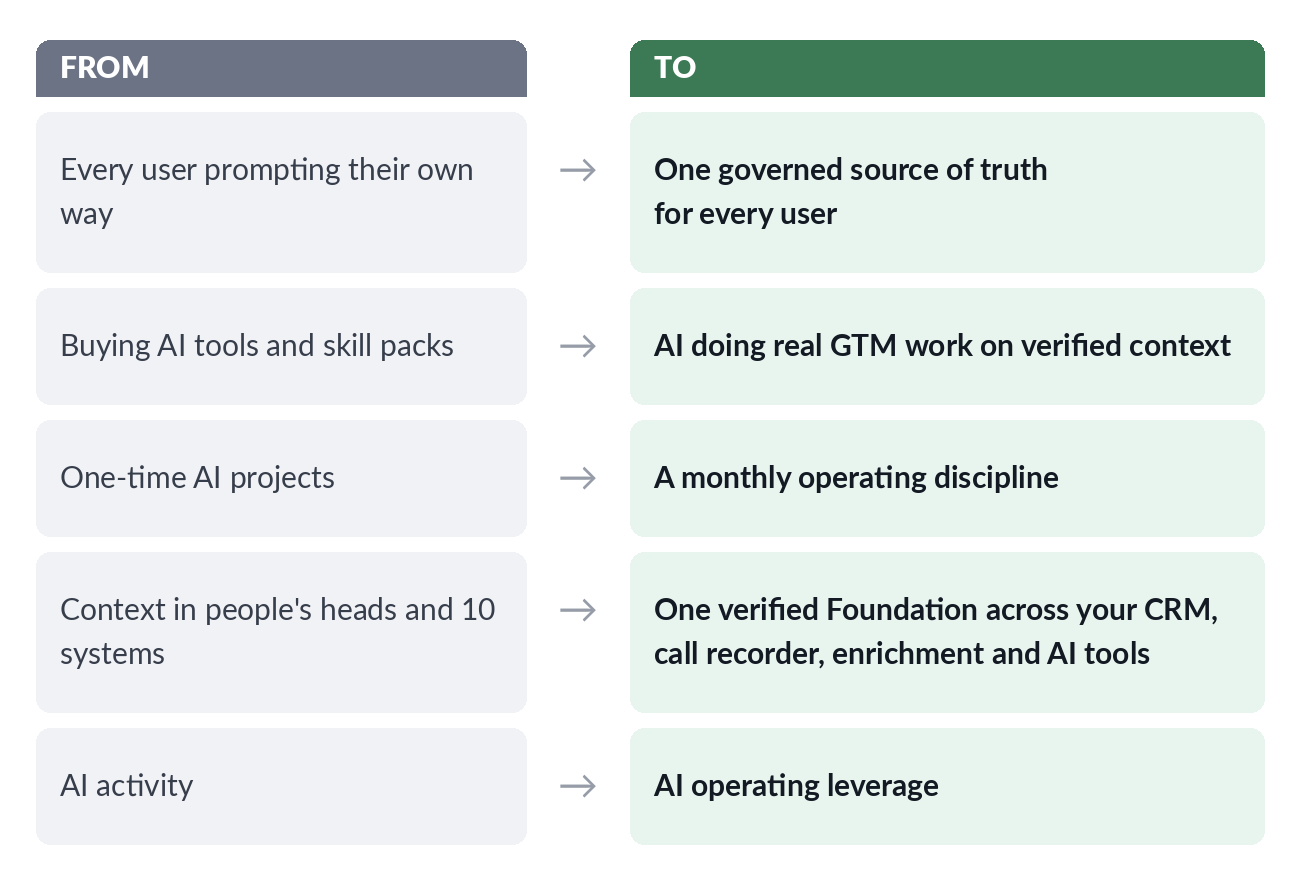
Every row on the left is a cost you’re already paying. Every row on the right needs an owner and a monthly cadence.
The platforms have done CEOs a favor. They made the case for context more clearly than any consultant could. Now your board will ask the follow-up: who owns your AI’s context?
If the answer is “the CRM,” you are carrying Context Debt you have not measured. If the answer is “our ops lead,” it walks out the door the day that person leaves.
Operating partners: ask this question at every portfolio company before your next value-creation review.
Start with the question every AI agent will put to you: could you point an AI at your CRM today and trust what it tells you? The AI Pulse Check will tell you in seven minutes.
The companies that build a verified Foundation this quarter will compound the value of every agent their platforms ship from here on. The companies that turn agents on and hope will pay interest on every action those agents take.


