Beyond the Productivity Hack: Engineering Real Operating Leverage with an AI GTM Stack
Jim Delaney
Mar 5, 2026
•
5
min read
Most companies are currently using AI to do the wrong things faster. They treat it as a series of disconnected productivity hacks—a slightly better way to write an email or a shortcut to summarize a meeting. But in a world of infinite noise, faster "copy-pasting" isn't leverage; it’s just noise reduction.
Real AI operating leverage—the kind that allows a lean team to out-execute an incumbent ten times its size—only happens when you stack AI into the core architecture of your Go-To-Market (GTM) motion.
Last week, I joined the PenFed Foundation in Bentonville, Arkansas, to speak with a cohort of veteran founders. While my session was titled "AI Go-to-Market Sales Tactics," the conversation quickly shifted to something deeper: the future of execution itself. We are moving from a world of heroic, founder-led selling toward repeatable systems that scale under pressure.
To achieve this, you must move from tool adoption to a unified engine for leverage.
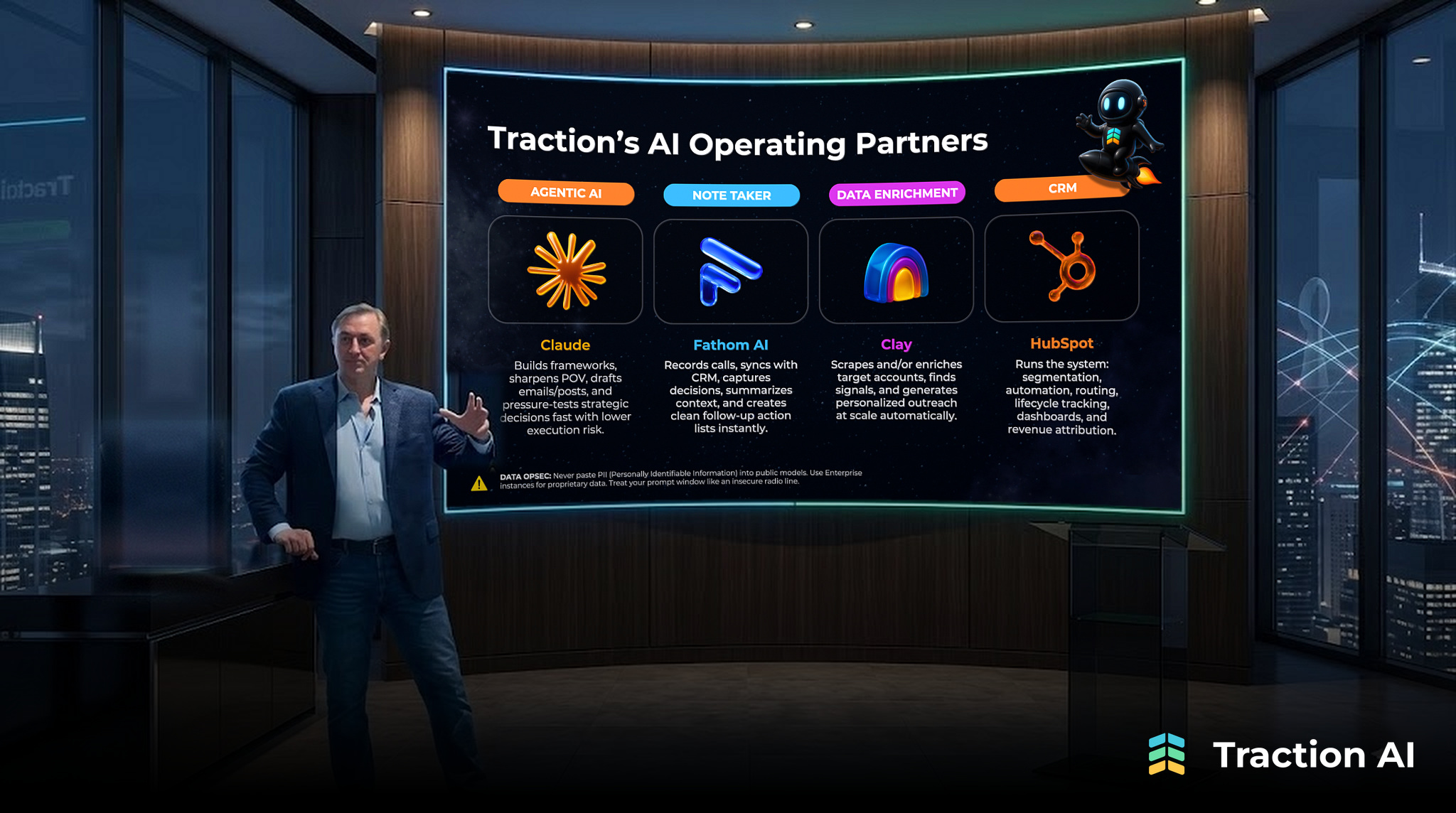
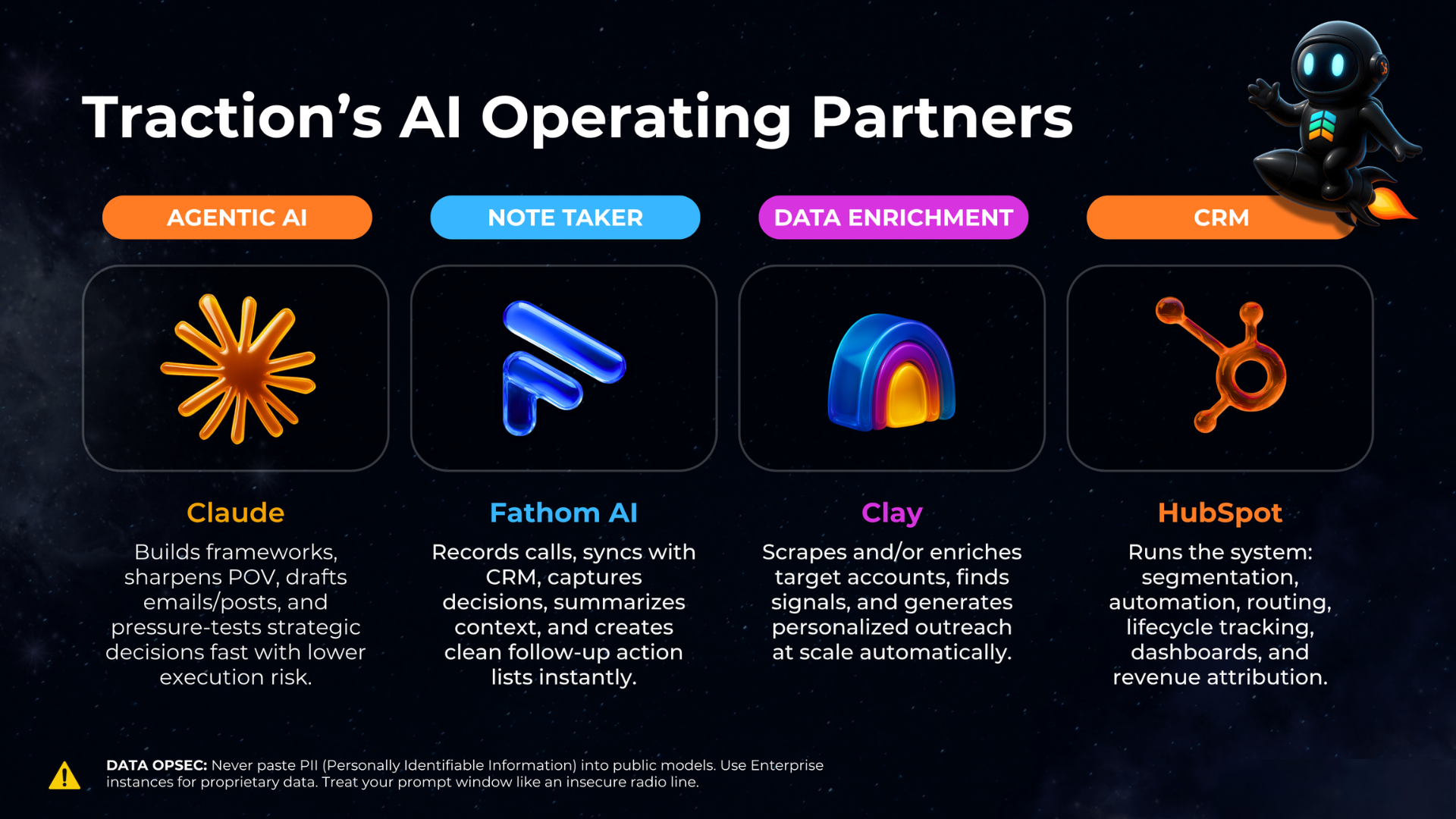
The Four Pillars: Traction’s AI Operating Partners
To create true leverage, we stack these tools so the output of one becomes the high-velocity, structured input for the next. These aren't just apps; they are coordinated partners integrated across your workflow.
ChatGPT(The Strategist): Used every day to build frameworks, sharpen your point of view, and pressure-test strategic decisions with lower execution risk.
Fathom AI (The Memory): Used every day to record calls, sync with your CRM, and instantly create clean follow-up action lists so no context is lost.
Clay(The Engine): Used as needed to scrape target accounts, find specific signals, and generate personalized outreach at scale automatically.
HubSpot (The Backbone): The system of record that runs segmentation, automation, routing, and revenue attribution.
I. AI for Sales: Protecting the Human Moment
In sales, AI shifts the advantage from outbound guessing to signal-based targeting. By offloading deep research and administrative tasks, reps can protect the essential "human moments" required in discovery and closing.
The "Prepare" Workflow
Growth used to be constrained by human bandwidth—research and qualification required expanding teams faster than revenue improved. That playbook is dead.
AI-Built Deal Briefs: Move from manual searching to comprehensive briefs that synthesize market research and competitor intelligence.
Persona Brainstorming: Identify the right decision-makers, their specific pain points, and their buying power before you ever pick up the phone.
Gap Identification: Use AI to pinpoint missing product-fit gaps or stakeholder map details before engagement.
The "Connect" Workflow
AI allows a small team to execute with a level of preparation that previously required a massive organization.
Hyper-Relevant Outreach: Generate messaging tailored to the industry context and the specific stage of the buyer’s journey.
Meeting Simulations: Use AI to role-play responses to objections or challenges, ensuring you navigate delicate conversations with a prepared framework.
Presentation Structure: Overcome the "blank page" by using AI to outline presentations based on target audiences and key points.
The "Drive the Deal" Workflow
Instant Action Items: Extract deal timelines and next steps from transcripts immediately after a call.
Sentiment & Risk Checks: Have AI "read between the lines" of email threads to identify red flags, such as legal hurdles or a shift in tone, before they become deal-killers.
II. AI for Marketing: Building the Growth Flywheel
Marketing AI transforms the traditional, linear funnel into a continuous, compounding loop where every asset feeds the next.
Understanding the Audience
Decision-Ready Readouts: Conduct market research that captures key insights and competitive positioning to differentiate your story.
ICP Development: Build personas based on real customer language to ensure your entire team is aligned on the triggers that matter most.
Designing Campaign Strategy
Theme & Message Testing: Build cohesive narratives and use AI to test message resonance before launching.
Funnel Mapping: Tailor messaging for awareness, consideration, and decision stages, ensuring content types match audience intent.
Creating & Optimizing Content
Brand Consistency: Use AI to uphold voice and tone, generating on-brand outputs with fewer manual rewrites.
The Content Multiplier: Repurpose long-form assets, like webinars, into short-form snippets or localized drafts for different regions and partners.
Measuring Performance
Data Summarization: Turn fragmented metrics into clear one-pagers and executive summaries.
Trend Identification: Spot drivers and patterns in content performance to uncover what needs adjustment in your creative or copy.
The "DATA OPSEC" Standard
As you build this architecture, intelligence must be balanced with security.
Public vs. Private: Never paste Personally Identifiable Information (PII) into public models.
Enterprise Instances: Use Enterprise-grade AI instances for all proprietary data.
The Golden Rule: Treat your prompt window like an insecure radio line.
Conclusion: Systems That Learn
We are witnessing an operating model shift. The highest-performing organizations are no longer asking, "How do we sell more?". They are asking, "How do we build systems that learn faster than our competitors?".
When intelligence is embedded inside the operating system of the company, decision quality improves at every step. You become faster, clearer, and more resilient.
Is your current toolset a collection of apps, or a unified engine for leverage?